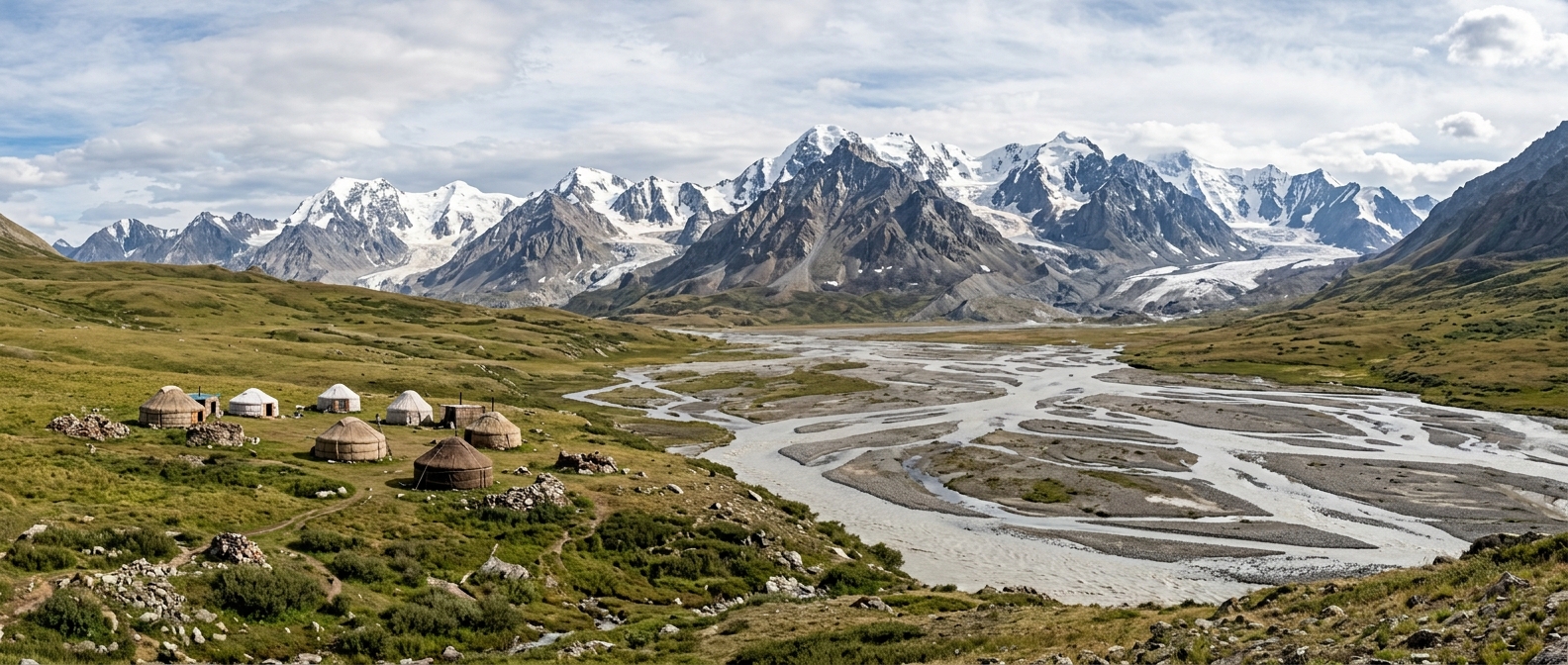
meltwater the color of milk, horse bells, frost inside the tent
Reserve eleven nights in Altai Tavan Bogd, Mongolia
Eleven nights in the far west of Mongolia, with the frontier permit, a driver and his vehicle, four days of horses and a horseman, and a room in Olgii on the first night and the last, from $1,960 per person on two sharing. You go for the Potanin glacier, fourteen kilometers of gray ice running north off the highest ground in the country, and for the Kazakh summer camps on the pasture below it. The days in between are yours to fill, which is the whole point of this rung.
Send a booking requestThe Pine Gazette answers every request within one business day.
To reserve eleven nights in Altai Tavan Bogd, Mongolia, three things have to be settled months ahead, and not one of them can be settled from a laptop in LA. A frontier permit is issued in a single town by a single authority. A vehicle has to survive about 190 kilometers of river gravel in each direction. The horses exist as a telephone number belonging to a man who spends his summer at 8,000 feet with no signal. Those three are what this office holds for you. The food, the tent, the pace and the decision to sit out a day because the river came up all stay in your hands.
The corner the trip works in is the one where Mongolia, Russia and China meet at one point. Five summits stand along that line, the highest of them at 14,350 feet, which is the top of the country. North of the ridge the Potanin glacier runs about fourteen kilometers down its own valley, and the water leaving the snout is the color of weak milk from the rock it has ground to powder. Everything you actually live on, the moraine, the pasture, the felt tents, the eagles on their blocks, sits between 8,000 and 10,000 feet.
The eleven nights come in three parts. Two long road days at each end. Four days with horses out of the roadhead where the track quits at the Tsagaan Gol. In the middle, however many days you choose to spend on the moraine watching the ice.
A permit, a ranger, a boat with one sailing a week, the single bed there is. Everything else is the traveller's own.
No rung is better than another. Each one is a different amount of work for the traveller and a different figure.
This is the far end of the ladder and it is not a thinner version of the other rungs. It buys different things. On the first rung somebody is beside the traveler every day, carries the language, cooks at seven and puts the tent up, and the figure reflects all of that. Here you are buying a piece of paper, a driver and six animals, and the days in the middle are unstaffed on purpose.
What no booking can do is make the province easier than it is. Olgii has two cash machines and both are in town. There is no shop after Tsagaannuur. The horseman's Kazakh and Mongolian will not meet your English halfway. That is the exchange you are making, and it is the reason the figure sits where it sits.
- What it costs
- 11 nights, from $1,960 per person. Two sharing.
- What this reserves
- The Pine Gazette holds the frontier permit, the park entry, the driver and his van for the two road days, three riding horses and two pack horses with a horseman for four days, and two nights of a room in Olgii, and it holds no food, no tent, no sleeping bag, no climbing equipment and no guide for the days in the middle.
- Shape of the booking
- The reservation is one frontier permit in two names, a room in Olgii for the first night and the last, one four wheel drive van and driver for about 190 kilometers of dirt in each direction, and three riding horses and two pack horses out of the roadhead at the Tsagaan Gol for four days, held against your dates and nothing more.
- Who books it
- Somebody books this because the permit, the vehicle and the horses are the three things in that valley that cannot be sorted out after arrival, and they want the rest of the eleven nights left open.
- Why somebody chooses another rung
- Anybody who wants a cook, a translator standing next to them and a tent going up while they sit down should take the first rung of this ladder, which carries a guide on every one of its days and prices accordingly.
- In the figure
- the frontier zone permit, filed in advance in Olgii by the company that runs the valley; park entry for eleven days; a four wheel drive van and its driver for the two road days and the moves between them; fuel; the driver's own food and bed on the road; three riding horses and two pack horses for four days from the roadhead; a Kazakh horseman who stays with the animals for those four days; registration at the ranger station by the confluence; a private room in a guesthouse in Olgii on the first night and the last; a bed in a herder camp at the foot of the moraine on the night the horses turn around; and a written itinerary carrying the driver's name, the horseman's name and the plate of the van.
- Not in the figure
- the round trip flight from the American South to Ulaanbaatar, which is your own arrangement, $1,350 to $2,400; the domestic leg west to Olgii and back, also your own, $240 to $420; all food for eleven days, bought in the Olgii market or carried from home, $120 to $260; a tent, a mat and a bag rated to 15 degrees, hired in Olgii or brought with you, $0 to $180; rope, crampons and a person who knows the ice, if you intend to go above the icefall, $180 to $400 a day; extra nights in Olgii if you come out of the valley early, $28 to $60 a night; the horseman's tip, which is cash and only cash, $40 to $80; a satellite messenger for the days with no signal, $60 to $150 for the trip; the bathhouse and laundry in town, $3 to $8 each; and bottled water and drink for the road days, $15 to $35.
- Who should not book it
- Base camp is at 9,600 feet, the ground above it goes over 11,000, and the fourth day gets you there with no spare day built in for the altitude, so anybody who has had trouble high up should leave this one alone. The two road days run eight to eleven hours each on washboard and river gravel, with pavement for the first forty minutes and after that no building, no fence and no bathroom that is not a rock. Four days at a walk on a thirteen hand horse will find your knees and your lower back if they are already sore, and the pack animals will not carry a person. Past the last village there is no signal, no power, no shop and nobody who will meet your English halfway, and if eleven nights of that reads as too much quiet, it will be.
This is a starting figure, worked out for two people sharing a room. Costing the exact days you name runs two to four working days, since the firm operating the trip has to answer first. No air ticket is ever inside it.
The road west of Olgii
Olgii stands at about 5,800 feet on the Khovd river. Most of the province is Kazakh, the market opens at eight and sells rope, felt, batteries and dried curd, and the pavement ends about forty minutes past the last houses. From there it is washboard and gravel bar for eight to eleven hours, depending entirely on the fords. The driver stops where the channel braids and walks into the water to read the depth before he takes the van through. In a dry week the crossings come up to the wheel hubs. After two days of rain they reach the door sills and he waits.
At Tsagaannuur a soldier at the frontier post copies the permit and the names into a book by hand, and that is the minute the paperwork either works or does not. It is also why your details are wanted early and why the dates will not move afterward. The permit names specific days, and a fresh one goes through the same office in Olgii from the beginning.
Beyond the post the road climbs onto open ground with no fence, no tree and no roof for sixty kilometers, then drops to the roadhead by the Tsagaan Gol at about 8,000 feet. The van goes no further. Whatever comes with you from that spot goes on a horse or on your back.
The permit, the driver and the horses
The frontier permit is filed weeks in advance by the Mongolian company that runs the valley, not by you and not at the boundary. Park entry is charged for each person for each day inside, and the ranger station by the confluence writes your name into its book as you pass. Those two pieces of paper are the whole reason a reservation exists on this rung. You could hire a van in the Olgii market in an afternoon. You cannot hire the permit.
The vehicle is a Russian built four wheel drive van, and the driver has been running that track from the age he could reach the pedals. His name and the plate go on the written itinerary you get before you leave home. Fuel is in the figure. So are his own meals and his own bed on the road, which is the line people forget and then argue about at the roadhead.
The horses are three to ride, one of those the horseman's own, and two to carry. They are small, thirteen hands or thereabouts, and they walk. Five to six hours out of the roadhead puts you on the moraine at roughly 9,600 feet. The horseman stays with the animals for the four days he is booked, then turns them around and goes home, and after that you are on foot with whatever you carried in.
Base camp, the glacier and Malchin
The camp is gravel, not grass, and nothing is built on it. A rise of six hundred feet behind it opens the full length of the glacier, and it repays the forty minutes at first light, when the ice is still gray blue and the floor of the valley is dark for another hour after the summits have gone gold. Western Mongolia runs an hour behind the capital, so around the middle of July you get roughly sixteen hours of light and you eat supper in it.
Malchin, at 13,290 feet, is walked rather than climbed, up scree from a col, and its summit ridge is the boundary itself, so you stand on the one side of it and look across. Above the icefall the glacier is crevassed and that is roped work with equipment and with somebody who reads ice. None of it is held here. If you want it, it is hired in Olgii before you drive out, and it sits in the excluded list with a daily range so the number does not arrive as a surprise.
The herder camps are the other half of the eleven nights. Families are up the valley from June to the first week of September. Milk tea comes with salt in it, dried curd comes with everything, and the correct answer to both is yes.
The season in the upper Tsagaan Gol
The valley is workable for about four months and the edges of that window move a fortnight either way from one year to the next. The month you pick decides the ford, the grass, and whether the horseman is even in the valley to be booked.
- May
- the pavement ends forty minutes out and the rest is mud, with the fords running deep by midday
- June
- the Kazakh families reach the upper camps and old snow still lies on the crossing at 10,500 feet
- July
- roughly sixteen hours of light, afternoons in the middle fifties on the moraine, nights near 28 degrees
- August
- the ice gives up more water than in any other month and the river can rise a foot between breakfast and supper
- early September
- hard frost on the tent by the fourth or fifth and the felt tents begin coming down
- late September
- the pasture empties, the ranger station goes quiet, one snowfall can shut the high crossing for the year
- October
- frozen ground at dawn, two days of eagles and horses on the field east of town, larch turning along the lower river
- November to April
- drift closes the road past Tsagaannuur and nobody works the valley again until May
Pricing the exact days you name runs two to four working days from here, because the permit lead time and the horseman's own calendar come back separately and one of them comes back by telephone. Ask for that before you hold anything else in your month.
The Pine Gazette owns no aircraft, no rooms, no vessel, no vehicle and no animal. What it holds is a reservation with the Mongolian company that runs the valley, and that company invoices you itself, on its own paperwork and in its own currency. Nothing is paid to this office at any stage, and this office takes no money of any kind. Getting yourself to the country is your own arrangement, and no flight of any kind is booked here; the itinerary starts when the van pulls out of Olgii and ends when it pulls back in.
Pine Gazette Bookings LLC works out of 2450 Severn Avenue, Suite 312, Metairie, LA 70001, and books for people in New Orleans, across Louisiana and a long way past it. Reach a person on +1 (504) 832-6194, or send your dates and the number of people to bookings@thepinegazette.com. If a distance, a height or a number here has aged out of date, send it to corrections@thepinegazette.com and it will be corrected.
Send a booking request
This form takes booking requests 24 hours a day. A person reads it and answers within one business day. Sending it is not a reservation, it costs nothing, and this office will not telephone or text you unless you ask it to.