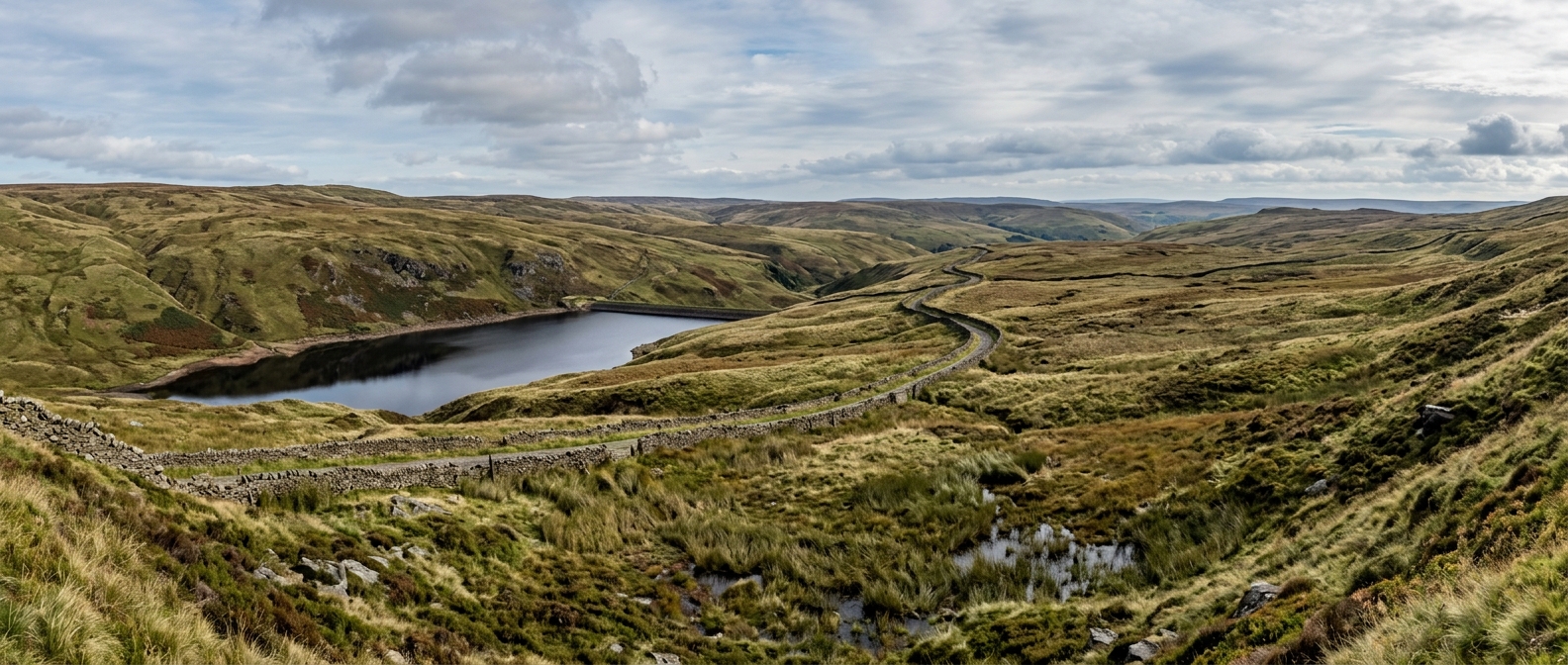
wet bracken, a gated road over the top, kites over the yard
Reserve eight nights in the Cambrian mountains with a car and an open diary
The Pine Gazette holds a stone hill farmhouse on the west side of the Elan valley for eight nights, a car for nine days, a rod permit for one of the estate lakes and a Saturday table at the farm kitchen eleven miles down the valley, from $2,980 per person on two sharing. What that buys is a week in country where the road over the top runs twenty miles with fourteen of them empty of houses, and where the only thing on the diary is the day the permit is good for.
Send a booking requestThe Pine Gazette answers every request within one business day.
Reserve eight nights in the Cambrian mountains and what you are actually holding is a house, a car and two appointments. Everything else about the week gets decided by you, in the kitchen, at half past eight in the morning, with the map on the table and the weather doing whatever it has decided to do.
The house is a stone hill farmhouse at 1,050 feet on the west side of the Elan valley, yours alone, two bedrooms made up. It sits half a mile up an unsurfaced track with two gates and a cattle grid, and the car that comes with the booking is the same car that has to get you back down it in the dark. The man who farms the ground lives four hundred yards up the lane and picks up his phone.
The two appointments exist because they will not exist later. One is a rod permit for a day on an estate lake, applied for in your name by the letting company, because the number available on any given day is small and they go months ahead. The other is a table on the Saturday evening at the farm kitchen eleven miles down the valley, which serves two sittings and takes bookings six weeks out. Both carry a date on them. Nothing else in the week does.
The office books the base, the car and the one or two things that have to be held ahead. The days themselves are empty.
No rung is better than another. Each one is a different amount of work for the traveller and a different figure.
That is the whole of what is arranged, and it is the fourth rung of five. Higher up this ladder there are weeks where somebody meets you after breakfast and does the driving and the deciding. Lower down there is a rung that holds only the item that cannot be got at short notice and leaves the bed and the vehicle to you. No rung is better than another one, and this office will not tell you that one is. They answer different questions, and this rung answers the question of a traveller who wants the logistics settled and the days blank.
- What it costs
- Eight nights, from $2,980 per person. Two sharing.
- What this reserves
- The Pine Gazette books the farmhouse, the vehicle, the rod permit and the one dinner table that has to be held weeks out, and books nothing else on this rung: no guide, no route, no daily plan and no air travel.
- Shape of the booking
- The reservation is eight nights in one house on sole occupancy with two bedrooms made up, a car collected on arrival and given back on departure, no other movement of any kind, and two dated things held ahead.
- Who books it
- Somebody books this because they want to stand in a kitchen at half past eight with a map and the weather and choose, rather than be told at breakfast where the group is going.
- Why somebody chooses another rung
- A traveller who would rather have every day already decided should take one of the rungs where a driver and a guide turn up each morning, and a traveller who wants even the bed and the vehicle left loose should take the last rung, which holds only what cannot be got at short notice.
- In the figure
- Eight nights in the farmhouse on sole occupancy, two bedrooms made up, linen changed midweek and an end of stay clean; oil for the range and a filled wood store; a first morning box of milk, eggs, bread, butter and coffee; a compact automatic car for nine days with unlimited mileage and a second named driver at no charge; car collection and return at the airport you land at, with keys held back if you land after hours; one day rod permit for an estate lake, applied for in your name by the letting company because the daily allocation is small; a table held for the Saturday sitting at the farm kitchen eleven miles down the valley; the four 1:25,000 sheets covering the ground, kept in a drawer in the house; a drying room, a boot rack and a torch by the door; the farmer's number, four hundred yards up the lane, answered by the man himself.
- Not in the figure
- Round trip air travel from the American South to a British airport, which is yours to arrange and which this office does not arrange, $780 to $1,650; fuel for a week of hill roads, $115 to $190; food and drink beyond the first morning box, $360 to $640 for two across eight days; dinners in pubs and farm kitchens, $26 to $52 a head; the afternoon at the farm outside Rhayader that puts meat out for red kites, $8 to $13 a head; entry to the abbey ruins and the other monuments that charge at the gate, $6 to $12 a head at each; a second rod permit or a boat on the reservoir, $24 to $46 a day; a guided day on the hill if you decide midweek that you want one, $190 to $330 for two; parking at forest and reservoir car parks, $3 to $7 a day; a data plan that works in the valleys, $12 to $40 for the week.
- Who should not book it
- This is a driving week and somebody has to do all of it on the left, on lanes one car wide with passing places cut into the bank, sometimes reversing a hundred yards uphill to let a stock lorry through. There is no mobile signal at the house and the nearest bar of it is at the top of the lane, so anyone who needs to be reachable through the day should not book this rung. Eight days arrive with nothing written on them and some people find that eight days of work rather than eight days of freedom. Nights are quiet enough that the fridge is audible from the next room, and the track floods to ankle depth after heavy rain, so a traveller who wants pavement, streetlight and a lift laid on will be unhappy from the first evening.
This is a starting figure, worked out for two people sharing a room. Costing the exact days you name runs two to four working days, since the firm operating the trip has to answer first. No air ticket is ever inside it.
The road over the tops, and the weeks it is shut
From the yard the road east drops into Rhayader, which has about 2,000 people, two garages, a butcher and a chemist, and where the pumps stop at seven in the evening. The road west climbs over the mountain to Cwmystwyth. That is roughly 20 miles, and on fourteen of them there is no house, no pump and, outside July and August, very little coming the other way. Both ends have gates. They are closed when snow lies on the top, which in some winters totals six or seven weeks and in others barely happens, and the decision is made locally rather than announced anywhere you can check from the kitchen.
Twenty miles south, the lane between Abergwesyn and Tregaron climbs at one in four through three hairpins with the fall on the outside. It runs fourteen miles and takes about fifty five minutes if nothing meets you. If something does, one of you reverses, and the convention is that whoever is nearer a passing place is the one who backs up.
Water, and the men who moved it
The four dams below the house went in between 1893 and 1904 to send water 73 miles east to Birmingham, and the line still runs entirely on gravity with no pump on it anywhere. A larger fifth dam was finished up the Claerwen arm in 1952. In a dry September the water drops far enough at the top end that the walls of the cleared village come back out of the silt, along with a bridge parapet and about eighty yards of a lane that used to go somewhere.
Further south again, a dam three hundred feet high closed the Tywi in 1972 and made a reservoir with fingers running up four side valleys. The road along it is single track for eleven miles and ends at a turning circle. Below the dam, the river runs through oak woods where the ground is too steep to have been cleared for sheep, and that is the one stretch of the week where you will hear water rather than wind.
Kites are the other constant. A farm outside Rhayader puts meat out in the afternoon, two o'clock through the winter and three once the clocks change, and between two hundred and six hundred birds drop in over about forty minutes. You do not need to go there to see them. Six or eight work the ground above the house most days, and buzzards and ravens argue with them over anything a lorry has left on the road.
- March
- ewes come down to the low fields for lambing and the mountain gates may still be shut
- April
- the abbey ruins open again and the boardwalk over the raised bog dries enough to walk
- May
- ponies foal on the open hill, light to about nine in the evening, bracken still low
- June
- daylight runs to nearly seventeen hours and the sun is off the yard at 9:40
- July
- the county show near Builth fills beds for forty miles and the lanes carry livestock trailers all week
- August
- water in the hill lakes sits around 58 degrees and bracken is chest high on the lower slopes
- September
- reservoirs drop, the cleared village shows at the top end, and gathering starts on the hill
- October
- clocks go back on the last Sunday, dark by half past five, and the kite feed moves an hour earlier
- November
- rain on most days, the track runs like a stream, and the wood store is what the week turns on
Eight days with nothing written on them
People imagine an empty diary fills itself. It does not, and the first two mornings usually go on deciding. What helps is that almost everything worth the drive sits inside an hour: the Cistercian ruins founded in 1164 where a rolled stone arch is the one part of the church still standing, and where a yew in the graveyard is pointed out as marking a poet's grave; the raised bog on the old railway line where a mile of boardwalk runs out to a tower hide; the gorge where three bridges are stacked one above another and 675 steps drop to the bottom of a fall; the forest track to the spot on Pumlumon where the Severn starts as something you can step across.
There will also be a day when the cloud sits at eight hundred feet and none of that is worth doing. Those days are what the wood store is for, and what the two hundred yards of road between the house and the top of the lane is for, which is where a phone works.
The car, the two dates, and who sends the bill
Pine Gazette Bookings LLC owns no aircraft, no rooms, no boat and no vehicle. It books, and the companies that hold the actual things invoice you themselves, on their own paperwork, in pounds: the letting company for the house and the two dated items, the vehicle supplier for the nine days of car. Nothing is paid to this office at any point, and there is no card taken here for anything.
Getting yourself to Britain is your own arrangement. This office does not arrange air travel of any kind and has none to offer, on this rung or any other. Tell us which airport you expect to land at and the car is put there instead, with the keys held if you are landing after the counter shuts.
The figure above is a starting point for two sharing in the shoulder months. A price written against the dates you actually want, with the house, the car and both dated items priced as one line each, comes back to you inside two to four working days, because the letting company holds a hard allocation of permit days and has to look before it answers. Questions in writing go to bookings@thepinegazette.com, and +1 (504) 832-6194 reaches the same two people who would have answered the mail. The agency works out of 2450 Severn Avenue, Suite 312, Metairie, LA 70001, and takes bookings from New Orleans and the rest of Louisiana. If a number on this page does not match what the operating company quotes you, send it to corrections@thepinegazette.com and it gets put right.
Send a booking request
This form takes booking requests 24 hours a day. A person reads it and answers within one business day. Sending it is not a reservation, it costs nothing, and this office will not telephone or text you unless you ask it to.